
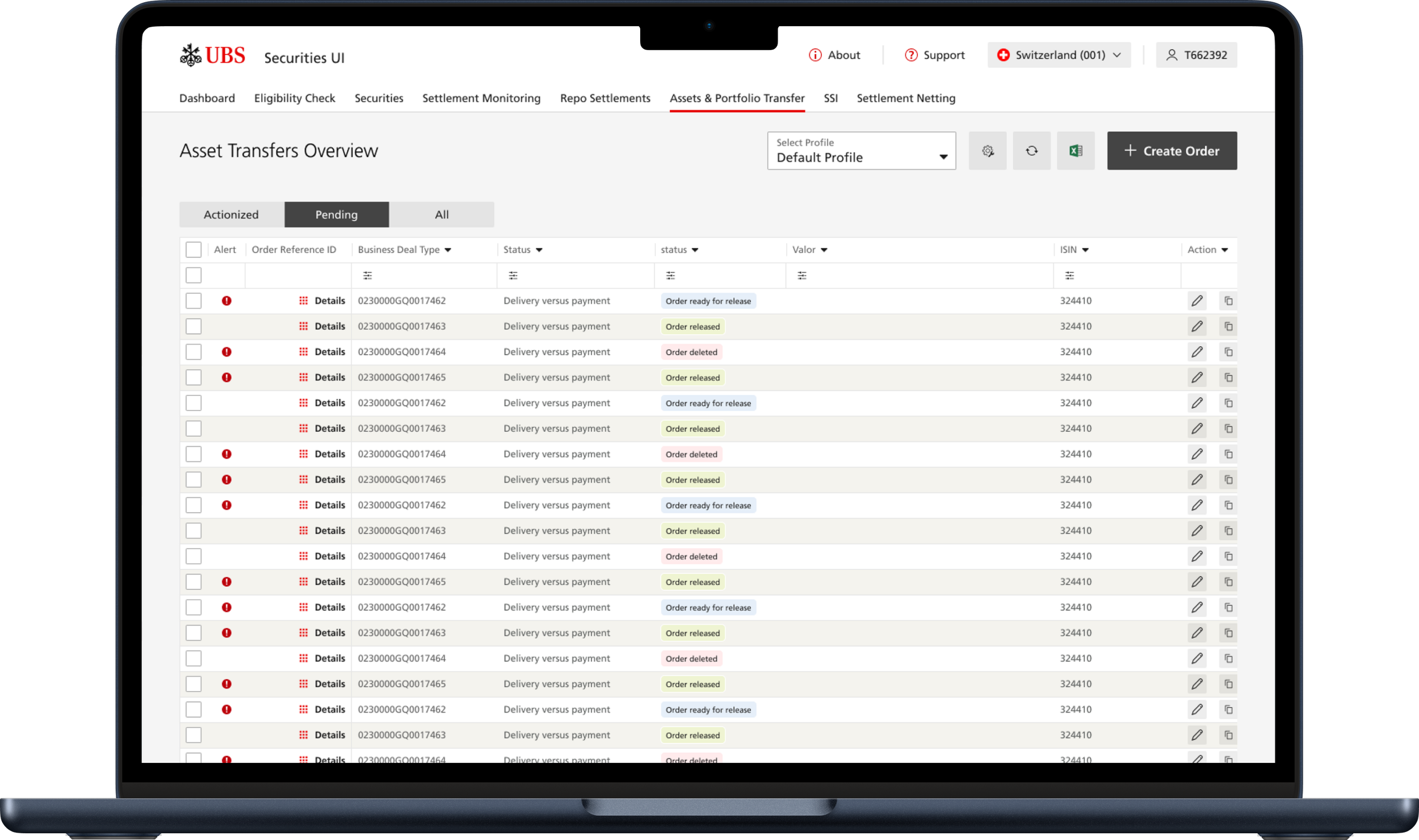
Asset & Portfolio Transfer — Internal Operations Platform
A high-risk internal tool designed to handle sensitive asset and portfolio transfers. The challenge wasn’t adding features — it was designing clarity inside a legally constrained, multi-step workflow used by specialists under time pressure.
Role: Product Designer
Scope: Complex flow design + system architecture
Area: Internal financial operations
Duration: 6–7 months
Team: Product + Engineering + Operations + Compliance
Overview
Asset & Portfolio Transfer was an internal platform built to support one of the most operationally heavy processes inside the organization: transferring financial assets across accounts, portfolios, and ownership structures.
These weren’t simple transactions. Each transfer involved regulatory constraints, multi-step validations, edge cases, and a high cost of human error. The existing tools were fragmented, difficult to learn, and heavily dependent on expert knowledge.
The goal of this project was not just to redesign screens — it was to redesign how people understand the transfer process.
We focused on turning a dense operational workflow into a predictable, structured system that reduces cognitive load and supports confident decision-making.
The challenge
Asset transfer flows combine legal rules, financial logic, and operational exceptions. Users needed to:
— navigate long, multi-stage processes
— verify sensitive financial data
— understand system states and dependencies
— avoid irreversible mistakes
The existing experience relied on institutional memory and training rather than interface clarity. New users struggled. Experienced users worked fast — but under constant mental pressure.
The design challenge was to build a system that:
— exposes complexity without overwhelming
— prevents critical errors by design
— scales across multiple transfer scenarios
— supports both novice and expert workflows
Approach
We treated the platform less like a dashboard and more like a guided operational workflow.
Key design principles:
Progressive disclosure
Only the information needed at each step is shown. Advanced data is available, but never forced.
State visibility
Users always understand where they are in the process, what’s completed, and what remains.
Structured validation
Errors are surfaced early and contextually, not at the end of the flow.
Decision scaffolding
The interface actively supports the user’s thinking instead of acting as a passive form.
We mapped the entire transfer ecosystem first — not just screens, but logic, dependencies, and edge cases — before designing the UI.
Design solution
The final system introduced:
— modular transfer flows adaptable to different asset types
— clear step-based navigation with visible system states
— contextual confirmations for high-risk actions
— inline validation instead of post-submission errors
— structured summaries before final execution
Instead of a long linear form, the experience behaves like a controlled decision engine.
Users move through a predictable rhythm:
input → validation → confirmation → progression
This pattern builds trust and reduces hesitation.
Outcome
The platform transformed a knowledge-heavy internal process into an interface-driven workflow.
It enabled:
— faster onboarding of new employees
— reduced operational errors
— clearer auditability of transfers
— higher confidence in execution
— less reliance on tribal knowledge
Most importantly, the system shifted complexity from the user’s head into the interface.
The tool doesn’t hide complexity — it organizes it.
Reflection
This project reinforced a key lesson:
In high-stakes environments, good design is not about speed or aesthetics. It’s about cognitive safety.
When financial decisions carry real consequences, the interface becomes a partner in thinking.
And that changes everything.